
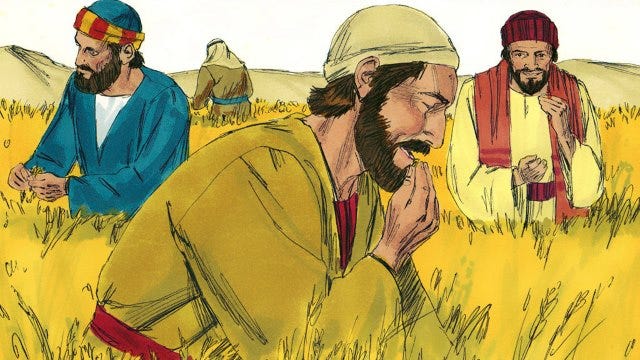
Though I’ve read this story several times over the years, recently as I read it, I was struck by a particular phrase in it—I felt there was something more I hadn’t seen before. I couldn’t see it at first but meditated for a few days and finally yesterday morning, I think God helped me make some connections to see more clearly what I was sensing. I’d like to share this with you as I realize He helps us learn His truth and desires we share it! So, the passage I read was Luke 6:1-5. In my Bible it is titled “Jesus is Lord of the Sabbath.” The main lesson in this passage is about Jesus declaring that He is indeed God and not just a rabbi and not even just Messiah, but He is more and ultimately Lord of all, including the Sabbath established by God from the foundation of the world.
In this passage, Jesus was going through the grainfields with His disciples, being trailed apparently by some Pharisees. Perhaps because they were out of food and hungry as they traveled the region preaching the Word of God, the disciples (in verse 1) “plucked the heads of grain and ate them, rubbing them in their hands.” Seeing this the Pharisees asked why they are doing what is unlawful on the Sabbath—basically equating their behavior with harvesting wheat and therefore “work.” Work was not allowed on the Sabbath as it was to be a day of rest dedicated to thanksgiving and worship of God.
Then, Jesus rebukes and corrects them, reminding them of scriptures which described a time that David with his warrior men actually ate the “showbread” from the temple which was only to be eaten by the priests. Then He declared in verse 5, “The Son of Man is also Lord of the Sabbath.” Just as David was anointed to be the priest-king of Jerusalem and therefore a priest in the Order of Melchizedek, Jesus became the high priest in the order of Melchizedek in becoming the priest-king of Jerusalem through His atoning sacrifice and identity as Lord. Therefore, David gave of the bread to His men, just as Jesus shared of His own wheat with His men. He is also, after all, the Lord of the harvest. The wheat the men ate in the fields represents the showbread or the Bread of the Presence. They ate this bread in the Presence of the Lord.
The showbread represents not only God as provider of sustenance, but also, God as provider of the Truth of His Word. Being tempted by the devil to turn a stone to bread, Jesus in His hunger fasting responded, “It is written, “Man shall not live by bread alone but by every word from the mouth of God.” Even more, the bread of the Presence in the temple foreshadowed the bread of communion in the new covenant that Jesus shared at the last supper. Luke 22:19-20 says, “And He took bread, gave thanks and broke it, saying, ‘This is My body which is given (or broken) for you; do this in remembrance of Me.’” In the passage just before this in Luke, the Pharisees asked why the disciples eat and drink and don’t fast like those of John the Baptist and Jesus said to them in Luke 5:34-35, “Can you make the friends of the bridegroom fast while the bridegroom is with them? But the days will come when the bridegroom will be taken away from them; then they will fast in those days.” So just like David’s men needed to eat in their battle, the disciples needed to eat in their hunger on the road with Jesus, their bridegroom. They ate in His presence awaiting the day when He would be taken and they would fast but for the sacrament of communion on the day of their Sabbath.
Now that we see these basics, let us explore a little further some connections in the passage with some of Jesus teachings from the book of John. In John 6:27, Jesus explains (after the miracle where He fed the crowds with the loaves and fish), “Do not labor for the food which perishes, but for the food which endures to everlasting life, which the Son of Man will give you, because God the Father has set His seal on Him.” The disciples “labored” for this bread, but in reality, we saw that it was foreshadow the bread of the Presence in the temple and that of His broken body, so even though they “worked on the Sabbath,” they were exempt in this symbolism eating in the bridegroom’s Presence. They “worked” for the bread that lasts.
Next, in John 4:31-38, the disciples came to Him right after He had spoken to the Samaritan woman at the well and they urged Him, “’Rabbi, eat.’ But He said to them, ‘I have food to eat of which you do not know.’ Therefore, the disciples said to one another, ‘Has anyone brought Him anything to eat?’ Jesus said to them, ‘My food is to do the will of Him who sent Me, and to finish His work. Do you not say, ‘There are still four months and then comes the harvest’? Behold I say to you, ‘Lift up your eyes and look at *the fields*, for they are already white for harvest! And he who reaps receives wages, and gathers fruit for eternal life, that both he who sows and he who reaps may rejoice together.’” Therefore, we can see that the disciples reaped the grain the fields of the harvest, foreshadowing their future ministry as apostles of the gospel reaping the harvest of souls for the fruit of eternal life, doing the will of the Father and finishing His work for them, just as Jesus said.
Finally, there is one more verse in John which is very telling. In John 12:24, Jesus says to His disciples just before His death, “Most assuredly, I say to you, unless a grain of wheat falls into the ground and dies, it remains alone; but if it dies it produces much grain.” This reminds us of the line in Luke that we began with, “His disciples plucked the heads of the grain and ate them, rubbing them in their hands.” Just as a grain of wheat falls to the ground and is crushed into the earth and gives rise to a harvest, the disciples crushed the grain in their hands and planted each grain of God’s broken body and Presence into the good soil and earth of their hearts, giving rise to their ministry they will one day embrace preached the Bread of Heaven in God’s Word and broken body and sacrifice for the sins of mankind, bringing in the harvest of many believers into the new blood covenant of God’s mercy.
As we can see, this one passage shows us through its rich symbolism and meaning that Jesus is indeed the Lord of the Sabbath and the Lord of all Creation, including the harvest that feeds both our bodies and our souls in His redeeming atonement for our sins. He made the Sabbath for man to eat of His body in communion and to remember what He has done for us each week in worship for one day. We must remember to thank Him on this special day set apart for our rest, as we work on the other six days eating the food of His will and finishing the work He has set out for us. So let us remember to keep the Sabbath and honor the Lord of it by eating of His bread and rubbing the grains of wheat to crush them and plant the bread of His Presence into the good soil of our hearts. May it give rise to a fruitful harvest in our lives as we touch others with His precious Presence of words of Truth. Praise You Lord for all You have shown us and done for us and given us. Thank You. Amen!