
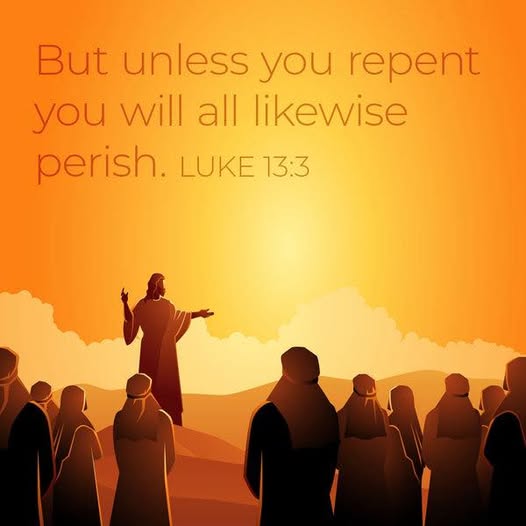
As I read Luke this morning, I saw a really interesting message I’d like to share today. The passage that made me pause was called “Repent or Perish” in Luke 13:1-5. It’s part of the same speech that began at the beginning of Luke 12 where Jesus was talking to an “innumerable multitude of people,” kind of like the Sermon on the Mount. When Jesus delivers sermons that get divided up into little sections and topics in our Bibles (understandably and rightly so), you can glean messages by looking at context around that section which is what I want to do today.
At the start of “Repent or Perish,” some of the people in the crowd told Him about certain Galileans whose blood Pilate had mingled with their sacrifices. Now, we don’t know what that incident was about. I tried to research it and couldn’t find a definitive answer other than the Galileans were particularly seditious and could have been persecuted at the Temple for refusing Temple money to Pilate. Either way, they were at the Temple offering sacrifices, possibly for sin, and died. Pilate made his point. So some people were likely asking Jesus why they died when they tried to atone for their sins.
Jesus’ response is interesting. He says to them in verse 2, “Do you suppose that these Galileans were worse sinners than all other Galileans, because they suffered such things? I tell you, no, but unless you repent you will all likewise perish.” He goes on to describe another incident in which the tower of Siloam fell on 18 in Jerusalem and asks if they think they were worse sinners, saying “I tell you, no; but unless you repent you will all likewise perish.” When Jesus repeats a message like that reiterating it, we know it is especially important to note. But guess what? He doesn’t just repeat it in this section, but He gives us many context clues to consider to better understand His message.
In the section just before this called “Make Peace with Your Adversary,” Jesus warns them to “judge what is right,” between themselves, on their way to the magistrate to be tried against their adversary and to make peace with them before they get there or else they may be thrown into prison. In other words, repent and make peace before you come before the judge, not just with your adversaries, but also repent to the Judge, your “adversary” being the wrath of God upon your sins, before you come to Judgment Day when you die and may get tried for your sins and sent to “prison.” Then He says, “I tell you, you shall not depart from there till you have paid the very last mite.” Unless you repent before you die, you will perish and pay for your sins to the last penny.
Who might our adversaries in this world be? He warns us in a section just leading up to this that they may be people in our own household and family. This section is called “Christ Brings Division.” Even though the birth of Christ we just heralded at Christmas came with a blessing of “peace on earth and good will to men,” this blessing is about the chance He brings for us to be reconciled to God in our repentance for our sins. Otherwise, Jesus says in this section in Luke 12:49-51, “I came to send fire on the earth, and how I wish it were already kindled! But I have a baptism to be baptized with, and how distressed I am till it is accomplished! Do you suppose that I came to give peace on earth? I tell you not at all, but rather division.” Then he goes on to describe how father will be divided against son and son with father; mother against daughter and so on—all in one’s family. Why? Over His cross. Within one house, one will believe and give their lives over to Christ even unto death and the other will hate them in their unbelief. In some cultures in Muslim or Hindu stories I’ve heard, parents even try to kill their children for converting. We try to reconcile with our friends and loved ones, but must always stand firm and pray for even our enemies to repent or they will likewise perish.
Right after this section, Jesus warns us to “Discern the Time,” pointing out that people know by looking at the sky when a storm is coming, but they are willfully ignorant of His message of repentance, calling them out saying, “Hypocrites! You can discern the face of the sky and of the earth, but how is it you do not discern this time?” And what “time” is this He speaks of? Jesus said to His disciples to preach the gospel and if anyone does not receive them, to tell them, “The kingdom of God has come near” and to dust their feet off and move on to show them they are rejecting the warning of God to repent or perish. This time is the preaching of God’s gospel of repentance and salvation—the Kingdom of God has drawn near to us all. We must respond to His call or one day, He will dust off His feet and move on. Then it will be too late for us when we come before the magistrate when we die.
There is one last section following the section we started with about the Galileans and Judeans who perished. It is called, “The Parable of the Fig Tree.” In this story, a man had planted a fig tree in his vineyard and asked his gardener to cut it down because it had failed to bear fruit for three years and was just using up the ground for nothing. So the gardener said, “Sir, let it alone this year also, until I dig around it and fertilize it. And if it bears fruit, well. But if not, after that you can cut it down.” For three years Jesus preached the gospel to the Jews. Yet many were hard hearted and unbelieving and never bore fruits “unto repentance” like John the Baptists warned to Pharisees who came to him to be baptized. The fig tree of Judaism failed to bear fruits unto salvation. Jesus allowed the gardener, the Father, to fertilize the tree of Judaism with the sacrifice of His cross and the gift of His Holy Spirit to the believing. If they yet fail to bear fruit, then they will be cut off just as we all will too.
In John 15:1-4, Jesus tells his disciples, “I am the true vine, and My Father is the vinedresser. Every branch in Me that does not bear fruit He takes away.” This warning is for believers—how much more so for those who have yet to even repent and believe! In another parable of a barren fig tree in Matthew 21:18-22, Jesus curses a barren fig tree that then dies. Dennis has taught me that this fig tree represents Judaism as the vehicle of salvation. With His incarnation and sacrifice, Judaism and Temple sacrifices cease to save one from Judgment. Only faith in Christ’s atoning sacrifice saves. So those Galileans that died and perished in the temple while sacrificing, whose blood was mingled with their sacrifice, needed Christ’s atonement because He had arrived. We too must take hold of Christ as our atoning sacrifice and not any other means of saving ourselves, whether we are Jewish or otherwise, whether we believe in atheism or the new age “universe,” whether we lean Buddhist or believe in Allah—we all need the covering of Christ’s shed blood for God’s judgment to “pass over” us—just like God showed the Jews before Christ’s arrival in the Passover event and celebration. We must realize the history of God’s chosen people the Jews all points the world to our Jewish Messiah, the Son of God.
So let us take heed of Jesus’ many warnings in this section of Luke—His message of salvation. The gospel brings peace but also division. We have to discern this time, this age of grace after Christ’s appearing and before His return, as it is rapidly coming to a close and we know not our last day. We have a precious opportunity to realize those Galileans and Judeans are no worse sinners than we are. Indeed, the Word says all have sinned and fall short of the glory of God. We have sinned and will likewise perish if we don’t repent and embrace God’s living vehicle of salvation—the cross and life of Jesus Christ. So let us repent and call all those around us to repent and be saved. Otherwise, we will all likewise perish. There is no more important call in our lives than this one. For those reading this who may not believe: Repent and be saved! Thank You Jesus for your warnings and wisdom. Thank You Lord for Your sacrifice and salvation. Amen.