
Today I want to look at a section of Luke that has always perplexed me, but recently I meditated on it deeper, and I think I may have some insight about it now that I’d like to share. This section is Luke 7:18-35 called “John the Baptist Sends Messengers to Jesus.” Now John was a prophet, even called the greatest of the prophets, because he was sent to “prepare the way” of the coming Messiah. He was filled with the Holy Spirit from the womb and was the first to leap and rejoice when Mary was pregnant with Jesus and went to visit his mother, Elizabeth.
Before he baptized Jesus at the start of his public ministry, John was conducting baptisms of repentance in the Jordan River. At that time, many sinners came to be baptized, believing in his message. But when the Pharisees and scribes and lawyers came to be baptized, John rebuked them sharply telling them not to presume they are sons of Abraham and to go and bear fruits worthy of repentance first because they were not truly repentant wanting to be baptized but likely were acting like religious police checking out John’s activities.
That’s a little background. Now John was eventually imprisoned by Herod for calling Herod out for being with his brother’s wife. In prison, he suffered so much he began to doubt his own ministry and asked two of his disciples to go and ask Jesus, “Are you the Coming One, or do we look for another?” This shows us that even the “greatest of the prophets” can doubt himself and God when faced with enough trial and suffering, just like us. And Jesus didn’t judge him, but rather, encouraged his disciples to go and tell him that “the blind see, the lame walk, the lepers are cleansed, the deaf hear, the dead are raised, the poor have the gospel preached to them. *And blessed is he who is not offended because of Me.*”
After John’s disciples had departed, He began to address the multitudes asking them what they expected to find in the wilderness when they went after John? A man in soft garments? He said those people live in luxury in the king’s courts. “But what did you go out and see? A prophet? Yes, I say to you, and more than a prophet.” Then He quotes an Old Testament prophecy that says, “Behold, I send My messenger before Your face, who will prepare Your way before You.” He then says no one born among women is greater than John, which is quite a statement. But then He makes an even greater statement! Saying, “but he who is least in the kingdom of God is greater than he.”
That’s us! The believer of Jesus, no matter how great his role in God’s kingdom, is greater than even John. Which says a lot because we also are called to “go and make disciples of all the nations” just like John, and to prepare the way for the unbelieving world to receive Christ in faith, to warn others to repent and believe. Upon hearing Jesus say all this, “even the tax collectors justified God” having been baptized by John. “But the Pharisees and lawyers rejected God’s will for themselves, not having been baptized by him.” This shows us God’s will is for *all* to repent, even the hardhearted. He is not biased towards some and not others. He sees all sinners as needing salvation. We all fall short of the glory of God. But some of those religious leaders did not receive His call, more concerned with power, pride, status, and greed and poor character they may even be blind to.
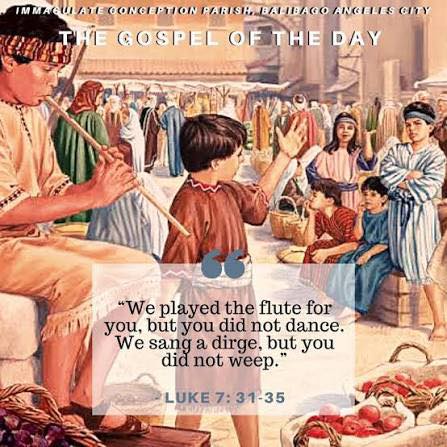
Then the Lord said, “To what shall I liken the men of this generation and what are they like? They are like children sitting in the marketplace and calling to one another, saying, ‘We played the flute for you, and you did not dance; We mourned and you did not weep.’ For John the Baptist came neither eating bread nor drinking wine, and you say, ‘He has a demon.’ The Son of Man has come eating and drinking, and you say, ‘Look, a glutton and a winebibber, a friend of tax collectors and sinners!’ But wisdom is vindicated by her children.” Now this last saying is what has always perplexed me. What does it mean?
When Jesus talks about the “people of this generation,” He is talking about the Pharisees and lawyers He had just addressed. And how were they like these children in the marketplace? What flute did they play expecting others to dance? And what did they mourn for show, expecting others to weep? What was their song and dance? The flute they played was their questioning and accusing the Messiah and God’s Holy Spirit by which Jesus accomplished His miraculous good works. They accused John of having a demon for not eating in the wilderness—accusing God’s Spirit the same way they accused Jesus of casting out demons by the power of Beelzebub or Satan. Hypocritically, they accuse Jesus of sinning because he dined and drank wine with tax collectors—when Jesus had already told them that He came to seek and save the lost and not the righteous (the Pharisees, not that they were any more righteous of course).
They played the flute of these accusations, expecting others to dance to their authority; but rather, the lower class of sinners believed on Jesus and many repented and rejoiced in His many good works! They were not persuaded by the Pharisees and lawyers “mourning” of Jesus’ “blasphemies” as He healed people on the Sabbat—as if they cared about God’s laws more than Him. They did this song and dance in public, in the marketplace, expecting others to follow them, but when the other children didn’t dance and weep for them, they complained: We did all this and you didn’t follow our lead.
So who’s flute and mourning did they follow? Jesus’ flute—calling sinners to repent and follow Him, to become faithful disciples. Jesus’ flute—calling them to dance and believe and rejoice in the good works and healings that He testified to John were taking place because of Him. The genuine mourning He showed in His compassion on the sick He healed even on the Sabbath, on the lost He redeemed to the truths He preached, on the loved ones of the dying in the dead He raised. That sorrow He revealed in the heart of God was the true mourning that led sinners to weep with Him in sympathy for His cause.
So when He says, “wisdom is justified by all her children,” who are wisdom’s children? Those who see the truth with a soft heart and dance to the true flute and mourn with the true Savior. Those who recognize Him as their redeemer and repent and follow Him. They will go forth and bear fruit for the kingdom of God, fruit that will last. They will share His wisdom and truth with a lost and dying world to draw others to the true faith of their salvation. Indeed, we are wisdom’s children when we reveal God’s truth in our lives lived in obedience to our Lord and Savior. We justify His truth in lives that reveal the kingdom of God to a dying world.
So let us take heart and be encouraged to continue to follow Jesus’ lead in our lives. Let us show that even the least in the kingdom of God is greater than even John the Baptist as we bring faith to others just as John did by calling them to repentance and preparing the way of our Lord. Let us play the true flute of Christ and mourn with His compassion for those suffering around us to draw others to His love and salvation and redemption just as we have been blessed to receive. For those who don’t yet know Him: don’t be like the Pharisees and lawyers who were offended because of Jesus. Soften your heart today and open your mind to truth and be blessed by Him instead. Let wisdom be your guide and embrace Jesus’ heart of love for you in faith. You will never regret it. Let wisdom herself be justified by the fruit you will go on to bear in your life lived for Him.