
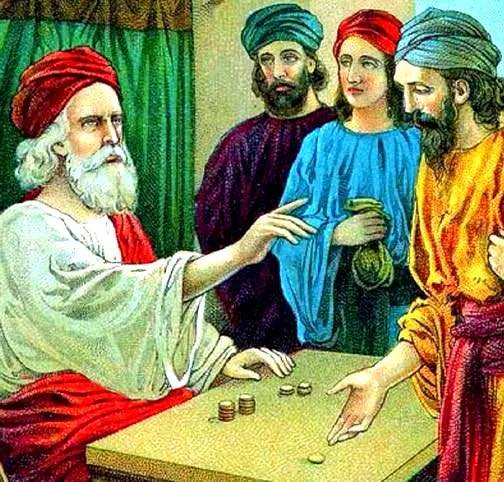
In today’s teaching I want to look at a very interesting parable of Jesus that reveals many, many insights for us to consider. It’s exciting to discover so much truth in this parable! First there is another similar parable in the gospel of Matthew (chapter 25) called the Parable of the Talents. The Parable of the Minas starts in Luke 19:11 right after the story about Zaccheaus, the tax collector that climbed into a tree to be able to see Jesus and when Jesus took note of him He said He would dine with Zacchaeus that night in his home. Zacchaeus promised to give half his goods to the poor and return any unjust tax he collected fourfold. Jesus told him, “the kingdom of God has visited you today.”Zachaeus went from being corrupt to righteous in his repentance and submission to the Lordship of Jesus. The Parable of the Minas follows this story and demonstrates not only wise financial stewardship, but also wise spiritual stewardship as it is an earthly reflection of the kingdom of God.
Luke 19:11 states that as the disciples heard Jesus tell Zachaeus that the kingdom of God has visited him, the disciples thought since they were near Jerusalem, “the kingdom of God would appear immediately.” They were expecting an earthly kingdom, so Jesus proceeded with this parable telling the story of a certain nobleman who “went into a far country to receive a kingdom for himself and to return.” This nobleman represents Jesus who is about to die and go to the far away country of heaven to receive for Himself the throne of His ultimate Lordship and return at the end of the age. So the nobleman in the parable calls ten of his servants to him and gives them each a mina to trade and invest until he returns. Dennis says these ten servants and minas represent the ten commandments or the royal law. I am not sure if they might represent anything different as well though. Interestingly each servant gets the same amount- one mina. This is a different detail than the Parable of the Talents in Matthew where 3 servants got differing amounts of talents and returned corresponding amounts of return on investment.
The Parable of the Minas focuses on three of the ten servants on the nobleman’s return. One says to him, “Master, your mina has earned 10 minas.” The master then says to him, “Well done, good servant; because you were faithful in a very little, have authority over 10 cities.” The master gives the same response to the servant that returns 5 minas, giving him authority over 5 cities. But the last servant says to the master, “Master here is your mina, which I have kept and put away in a handkerchief. For I feared you, because you are an austere man. You collect what you did not deposit, and reap what you did not sow.” The master calls him a “wicked servant” and takes his mina and gives it to the one who has 10.
Then Jesus says to the disciples, “For I say to you, that to everyone who has will be given; and from he who does not have, even what he has will be taken away.” Finally, for those citizens that said, “We will not have this man to reign over us,” when he left, he says upon his return, “But bring here those enemies of mine, who did not want me to reign over them, and slay them before me.” These are those who reject the Lordship of Christ in this life and world and will be cast away at the end of the age and will perish in the fire. Dennis says the one mina each servant received is one’s life. In the parable of the talents, it is a material or spiritual gift.
The bottomline is—do we use our life and our gifts in the “trade” of performing faithfulness to God in the small things (“…because you have been faithful in little…”)? Do we actually bear fruit for God? As in the parable of the good soil, when the Word of God is sown into the soil of our hearts, are we humble and repentant and reverent to God and His truth? Are we prepared to bear fruit 30, 60, and 100 fold? Or are we like the seed that was sown in stony ground of a hard heart like the wicked servant who gave back his mina, fearing God in the wrong way as an unjust judge whose holiness is not also defined by His love and mercy?
1 John 4:15-17 states, “If anyone acknowledges that Jesus is the Son of God, God lives in them and they in God. And so we know and rely on the love God has for us. God is love. Whoever lives in love lives in God, and God in them. This is how love is made complete among us so that we have confidence on the day of judgment: In this world we are like Jesus.” So being faithful to the little thing entrusted to us is to be faithful to the love God has shown us through the cross by following Him in the journey to become more like Christ, to be sanctified. To fear Him justly is to submit to His reign over us, as His servant, and to steward the gift of salvation entrusted to us. We do this by honoring His Word and abiding in Christ—in His Spirit.
In John 15:5-8 Jesus states to His disciples the night before His death, “I am the vine, you are the branches. He who abides in Me, and I in him, bears much fruit; for without Me you can do nothing. If anyone does not abide in Me, he is cast out as a branch and is withered; and they gather them and throw them into the fire and they are burned. (These are the nobleman’s “enemies” that he slew on his return after becoming king) If you abide in Me, and My words abide in you, you will ask what you desire, and it shall be done for you. By this My Father is glorified, that you bear much fruit; so you will be My disciples.” The fruit we bear is for God’s glory. The wicked servant denied this glory, stating that God “reaps where you do not sow” imagining that his effort in trading going to God was unjust of God. But, in reality, all we have already belongs to Him and will always go back to Him no matter what.
This whole creation exists for the glory of God. Nature itself praises God. Psalm 19:1-4 states, “The heavens declare the glory of God; the skies proclaim His handiwork. Day after day they pour forth speech; night after night they reveal knowledge. They have no speech, they use no words; no sound is heard from them. Yet their voice goes out into all the earth, their words to the ends of the world.” To deny God the glory that comes from the fruit we bear in our sanctification does Him injustice because that glory belongs to Him. To accuse Him of taking what He didn’t earn is wicked for we would not be capable of bearing fruit without Him. When we “trade” our mina, we are simply faithful to take risks in faith with the gifts He has given us, to abide in His Spirit and obey His Word daily even in the mundane things. God is the one who sows His Spirit in us and reaps the fruit.
And what does God reward the faithful servants with? Authority over cities, to each according to his return. This authority is spiritual authority. James 5:16 says, “The prayer of a righteous man availeth much.” Just like Jesus said in the passage in John we just looked at, when we abide in Him, God will answer the things we ask of Him—our prayers avail much. We have authority to ask “in Jesus’ name.” We gain authority in the spiritual battle with darkness and Satan when we put on our armor in God. Our faithfulness in little bears fruit for the glory of God and earns us the reward of spiritual authority in His kingdom.
Unlike the Parable of the Talents where the three servants were given differing amounts of talents according to their abilities (different spiritual gifts that may result in a differing measure of harvest—30, 60, or 100-fold), each servant in this parable is given only one mina. We all get one salvation. Ephesians 4:4-6 states, “There is one body and one Spirit, just as you were called to one hope when you were called; one Lord, one faith, one baptism; one God and Father of all, who is over all and through all and in all.” That one mina is His saving grace. How we respond is of utmost importance.
Are we willing to make Him Lord of our lives and welcome His reign over us or do we reject Him? Do we revere Him as a God whose holiness is defined as much by love, mercy, graciousness, generosity and justice as it is by moral purity and perfection? Are we faithful to invest and trade our mina through abiding in His Word and laying down our lives for one another? Are we using our one life and our one salvation to His glory? Are we pursuing His works faithfully?
Ephesians 2:8-10 says, “For it is by grace you have been saved, through faith—and this is not from yourselves, it is the gift of God—not by works, so that no one can boast. For we are God’s handiwork, created in Christ Jesus to do good works, which God prepared in advance to be our way of life.” When we are faithful to the mina of salvation and submit to our sanctification, we are faithful to do the works of God—small or large, whether in blessing or suffering—and serve those around us and do right by the good, loving, and holy heart of God.
Also, do we fear God’s judgment or have anxiety that we are not doing good enough or enough at all? Do we not realize that when we love God and do our best, His word promises that He views us through a heart of compassion? Psalm 103:13-14 says, “As a father has compassion on his children, so the LORD has compassion on those who fear Him; for He knows how we are formed, He remembers that we are dust.” God knows you are only human. Fearing Him is to love Him and pursue Him, to obey His will even if imperfectly. Even when we backslide, God only expects us to return to Him with repentance so that He can receive us in faith.
So if you’re wondering if you are honoring His mina sufficiently when indeed you love and fear Him in evident ways in your life, you need not fear Him or have anxiety. All we can do no matter where we are is to seek Him and discern His will for our lives. We can ask Him honestly, am I trading Your mina in the way that will bear most fruit? Is there anything You would have me do or pursue, Lord, to bring you more glory? Whether we ‘hear’ from Him through the study of His Word or through the still, small voice in our heart or mind, or through dreams or signs in nature or any of the numerous ways He talks with us, He is faithful to answer your call and guide you. Indeed, He knows your heart to grow in Him and honor Him, and He will honor that love because according to the book of Revelation, He is named “Faithful and True.”
Given all this parable has shown us today, let us be faithful to the mina of salvation we receive as one of God’s subjects. Let us be a faithful steward in the small things so that God may bless us with spiritual authority in the battle and in His kingdom—for the sake of our prayers. Let us bear fruit in doing the works God prepared to be our way of life and abiding in the vine of Jesus to become more like Him—fruit that brings glory to God. Let us warn others in love that God is love and has called us to make Him Lord, but He has warned of the danger we face if we refuse His Lordship or misrepresent His holiness and fear Him as an unjust judge. Thank You Lord for Your warnings and promises in Your Word and for all the rich insights You reveal and share with us about how to find blessing in You. We give You all the praise and glory! Amen.