
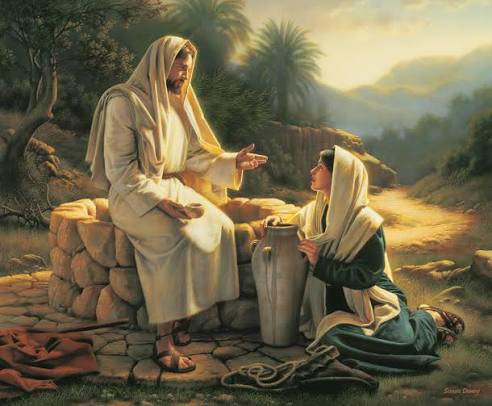
Today I’d like to look at a fascinating encounter between Jesus and a certain Samaritan woman in John Chapter 4. It is a well-known scene, and there are many teachings on it already. What I’d like to look at that I noticed today is the connections between the section before Chapter 4 and right after the encounter. The way these sections tie into the encounter were interesting to me and telling. I will try to examine this as clearly as possible, but it is somewhat challenging so bear with me! Here we go!
First off, the section just before Chapter 4 is called “John the Baptist Exalts Christ” in John 3:22-36. After the encounter with Nicodemus that we looked at in the last teaching called “Born Again,” Jesus and His disciples went to Judea and were baptizing in a similar area as John and his disciples. Some of John’s disciples came to him and said that Jesus and His disciples were also baptizing and why? So, John gave a short speech about Jesus to them to explain some truths. This speech relates directly, piece for piece to the encounter with the Samaritan woman. We’re going to break it down now.
The first thing he says to them is, “A man can receive nothing unless it has been given to him from heaven.” James 1:17 also says, “Every good and perfect gift is from above, coming down from the Father of the heavenly lights, who does not change like shifting shadows.” In the encounter with the Samaritan woman, Jesus was resting next to Jacob’s well in Samaria while His disciples had gone to town to buy food. He was hot and tired and the Samaritan woman, who was likely an outcast and couldn’t come with the other women of the city in the morning, had come alone in the “sixth hour” to get water. Jesus asked her, “Give Me a drink.” Surprised at His forward request, she said to Him in verse 9, “How is it that You, being a Jew, ask a drink from me, a Samaritan woman?”
Neither would a man ask a woman for a drink, nor a Jew ask a Samaritan for these things were taboo in that time. There was prejudice between Jews and Samaritans as the Samaritans believed in a variation of the Jewish faith with their own laws and they worshipped on Mt. Gerizim instead of Jerusalem. So, Jesus then answered her and said, “If you knew the gift of God, and who it is who says to you, ‘Give Me a drink,’ you would have asked Him, and He would have given you living water.” So indeed, every gift is from above just like Jesus, the gift of God, from the Father of heavenly lights—just as John the Baptist told his disciples and James wrote in his epistle.
Later, John the Baptist says, “He who comes from above is above all; he who is of the earth is earthly and speaks of the earth. He who comes from heaven is above all. And what He has seen and heard, that He testifies. He who has received His testimony certifies that God is true. For He whom God has sent speaks the words of God, for God does not give the Spirit by measure.” So, right after Jesus tells the woman that He can give her living water, she confronts him with her earthly reasoning and understanding, (just like John just said), saying to Him, “Sir, you have nothing to draw with, and the well is deep. Where then do you get that living water? Are you greater than our father Jacob, who gave us the well and drank from it himself?” Then, speaking the words of God from heaven that testify by the Spirit of truth from above, Jesus answers her saying, “Whoever drinks of this water will thirst again, but whoever drinks of the water that I shall give him will never thirst. But the water that I shall give him will become in him a fountain of water springing up into everlasting life.”
This fountain of living water is the gift of the Holy Spirit when one receives Jesus as their Messiah and Savior by faith. The wellspring of the Holy Spirit will flow through the believer and renew their spirit unto eternal life. Just like John the Baptist had just said, “For He whom God has sent speaks the words of God, for God does not give the Spirit by measure,” Jesus spoke God’s holy words to the woman in the fullness of the Spirit’s pure truth, and this Spirit is not given by measure but rather in a wellspring the gushes up to heaven and eternity! A good and perfect gift from the Father of heavenly lights!
The next thing John the Baptist says is, “The Father loves the Son and has given all things into His hand. He who believes in the Son has everlasting life; and he who does not believe in the Son shall not see life, but the wrath of God abides on him.” This everlasting life is the very gift that Jesus promises to those who come to drink the living water He offers, to those who receive Him as the good and perfect gift from above, as the only Son of God and Messiah—just like this Samaritan woman.
Another thing John the Baptist said in this section is, “He who has the bride is the bridegroom; but the friend of the bridegroom, who stands and hears him, rejoices greatly because of the bridegroom’s voice. Therefore, this joy of mine is fulfilled.” The bridegroom he is referencing is Jesus. He is our bridegroom as He has come to marry His people and prepare the bride of His church for the wedding supper of the Lamb at the end of time. In Matthew 9:15, Jesus said to the Pharisees who were asking why His disciples wouldn’t fast like John’s disciples, “How can the guests of the bridegroom mourn while He is with them? The time will come when the bridegroom will be taken away from them; then they will fast.”
Not only was John’s joy fulfilled, but so too was the Samaritan woman’s joy fulfilled. Through the course of her exchange with Jesus, he confronted her about her 5 husbands, revealing his intimate knowledge of her life. She said to Him that He must be a prophet, and when she eventually discovered that He was indeed the Messiah, she dropped her water jar and ran back to town with joy and excitement sharing boldly with anyone who would listen that she met a man “who knew everything” about her and that He must indeed be the Christ! She received His testimony and certified that, indeed, God was true. Her joy and testimony were so powerful that many Samaritans received Christ and indeed they invited Him to stay with them. Jesus stayed with them for two days and many came to believe in Him, their joy made complete by the bridegroom.
When the Samaritan woman said to Him, “I perceive you are a prophet. Our father’s worshipped on this mountain, and you Jews say that in Jerusalem is the place where one ought to worship,” Jesus said to her, “Woman, believe Me, the hour is coming when you will neither on this mountain, nor in Jerusalem, worship what you do not know; we know what we worship, for salvation is of the Jews. But the hour is coming, and now is, when the true worshippers will worship the Father in spirit and truth; for the Father is seeking such to worship Him. God is Spirit, and those who worship Him must worship in spirit and truth.”
When all the Samaritans received Christ by faith in joy, they showed salvation was indeed of the Jews, but it was also available to ALL, Jew and Gentile, especially the non-Jew as many were some of the first believers when many Jews actually rejected Jesus in their greed, unbelief, and pride. The Father was indeed looking for worshippers not from a particular faith, but rather those who would humble themselves to recognize and appreciate the gift from heaven He sent for their redemption from hell and judgment—His Son and our Messiah.
The next thing the Samaritan woman says to Him, is “I know that Messiah is coming. When He comes, He will tell us all things.” Jesus then said to her, “I who speak to you am He.” She had a most amazing and unique encounter with the one and only Christ, who indeed told her all things and brought her to faith as she trusted Him and took Him at His words as a simple child, rejoicing just like John the Baptist in her encounter with the bridegroom. Her joy was fulfilled.
Right after saying his joy was fulfilled, John the Baptist told his disciples, “He must increase, but I must decrease,” showing that his role was to simply prepare the way for Jesus, so that people would recognize Him by faith and repent and receive Him. He was not the star of the show, though his disciples looked up to him and even Jesus said there was no greater born of women than John the Baptist. So, too, the woman was of no account but simply pointed her town to the gift of God in Christ. So, too, we are likewise of no account but to bear Christ’s message, who is above all from heaven and brought us the message of salvation and made a way for us to drink of His living water and enjoy that wellspring of eternal life within us.
So let us take to heart the lessons we’ve gleaned from John Chapters 3 and 4 today. Let us too receive our Lord’s testimony and certify that, indeed, God is true. Let us be like this unique first evangelist of our Lord, the Samaritan woman, and bring a childlike faith and humble, believing heart to the message of our Lord so that we too may encounter the Messiah as we seek to draw water from our well for the day. We draw on the water of this earth to meet our daily needs, but indeed our true need is in Christ’s living water of the Spirit. Let us go to Him and ask Him, “Lord, give me a drink of Your true and living water” by faith, for we know He has said to us He gives us perfect gifts from above, and the Spirit He does not give by measure. Indeed, He gives us a fountain flowing to everlasting life! Therefore, let our joy be fulfilled in the voice of our bridegroom!
Finally, run back to town and share that joy with those around you. We all need that living water and many may come to believe your testimony and invite Christ into their lives to stay with them because of you, just like those Samaritans believed the woman at the well. And remember, just like John the Baptist, we must decrease and He must increase! Let us set ourselves aside and lift Him up and make Him the center of our message and lives. Let us worship in spirit and truth for the Father is seeking such to worship Him. Amen.