
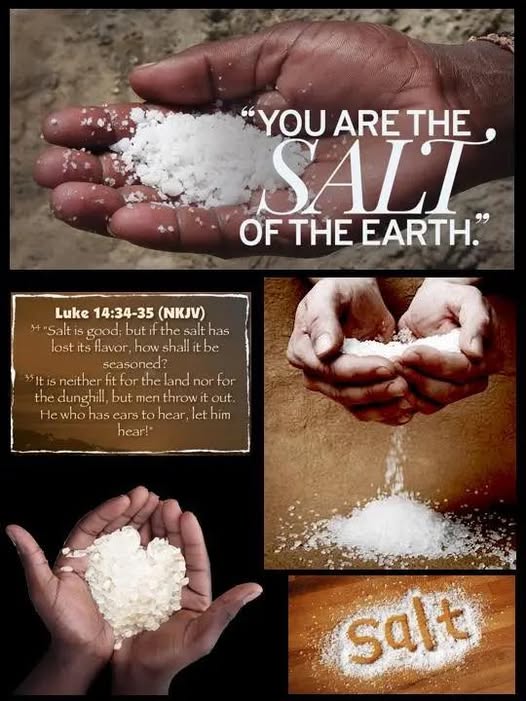
Today’s study begins with a saying in Luke 14:34-35—a really short one packed with meaning. It’s about salt and there are parallel scriptures in Mark and Matthew also that will help shed light on this verse as well. In this teaching we will explore what Jesus may have wanted us to learn or consider in this enigmatic saying of His. So the scripture in Luke says: “Salt is good; but if the salt has lost its flavor, how shall it be seasoned? It is neither fit for the land or the dunghill, but men throw it out. He who has ears to hear, let him hear!” Indeed, let us hear! In this saying, Jesus focuses on a few of the many uses of salt in His day. Most commonly salt is used to flavor food. It is a common but very valuable item in His day, even a currency. Roman soldiers used to get paid in salt, which is the origin of our word “salary.” I’ll get to the function of flavoring in a moment, but first I wondered how is salt used on a dunghill? Or on the land?
On a dunghill, salt can disinfect germs and control odor; it can help it burn as fuel; and it can improve manure’s fertilizer quality for farming. On the land, the right amount of salt can fertilize plants, while too much prevents growth. It also melts snow on roads. Salt is also used in soap and detergent and was commonly used at that time to preserve food like meats. In this verse in Luke, I have heard that salt cannot actually lose its flavor, so what does Jesus mean when He says this? Well the version of this verse in Matthew 5:13 says, “You are the salt of the earth; but if the salt loses its flavor, how shall it be seasoned? It is then good for nothing but to be thrown out and trampled underfoot by men.” So, in this verse, Jesus directly says that *we* are the salt He is referring to in these sayings. And what does the expression “salt of the earth” actually signify to us when we refer to men? Good, honest, humble people. So even though salt can’t technically lose its flavor—the salt he refers to is people who may lose their goodness, honesty, and humility straying in sin.
Proverbs 25:26 says: “Like a muddied spring or polluted well is the righteous who give way to the wicked.” Colossians 4:2-6 also gives us an idea of how salt in our beings is both a preservative and a flavoring saying: “Devote yourselves to prayer, being watchful and thankful. And pray for us too, that God may open a door for our message, so that we may proclaim the mystery of Christ, for which I am in chains. Pray that I may proclaim it clearly, as I should. Be wise in the way you act towards outsiders; make the most of every opportunity. Let your conversation be always full of grace, *seasoned with salt*, so that you may know how to answer everyone.” As a preservative we are always in prayer that we may share the gospel in a dying world that is passing away—to bring salt and light to those in darkness, the message of deliverance and love. We speak words of truth and grace like our Lord Jesus did—we share His message in love, using wisdom in how we respond to this complex landscape of cultural push and pull—of evil distorting truth and reality in the minds of the blind.
Another passage in Colossians 3:12-17 shows us how to bear fruit in our saltiness and flavor. It states: “Therefore, as God’s chosen people, holy and dearly loved, clothe yourselves with compassion, kindness, humility, gentleness and patience. Bear with each other and forgive one another if any of you has a grievance against someone. Forgive as the Lord forgave you. And over all these virtues put on love, which binds them all together in perfect harmony. Let the peace of Christ rule in your hearts, since as members of one body you were called to peace. And be thankful. Let the message of Christ dwell among you richly as you teach and admonish one another with all wisdom through psalms, hymns, and songs from the Spirit, singing to God with gratitude in your hearts. And whatever you do in word or deed, do it all in the name of the Lord Jesus, giving thanks to God the Father through Him.” That one scripture pretty much sums up how to be salt of the earth and have flavor in this world—to love God and love others which is indeed God’s Law for us to obey.
Jesus said in Matthew 7:16-20 that we will recognize these people—the salt of the earth—by their fruit, saying: “By their fruit you will recognize them…Every good tree bears good fruit, but a bad tree bears bad fruit…Every tree that does not bear good fruit is cut down and thrown into the fire. Thus, by their fruit you will recognize them.” This brings us to the salt verse in the book of Mark 9:49-50 which says: “Everyone will be salted with fire. Salt is good, but if it loses its saltiness, how can you make it salty again? Have salt among yourselves, and be at peace with each other.”
What does it mean to be salted with fire? Well salt is used throughout the Bible to refer to judgment. Lot’s wife turned to a pillar of salt. Deuteronomy 29:23 describes how “the whole land is brimstone, salt, and burning” when faced with God’s judgment. Psalm 107:34 talks of God turning a “fruitful land in a salty waste (or barrenness)” since too much salt prevents any plant growth.
Furthermore, being salted with fire and being a tree that bears bad fruit is directly referenced in Matthew 3:10-12 where John the Baptist warns the Pharisees and Sadducees, “The axe is already at the root of the trees that does not produce good fruit will be cut down and thrown into the fire. I baptize you with water for repentance. But after me comes one who is more powerful than I, whose sandals I am not worthy to carry. He will baptize you with the Holy Spirit and fire. His winnowing fork is in His hand, and He will clear His threshing floor, gathering His wheat into the barn and burning up the chaff with unquenchable fire.”
Hebrews 10:26-27 goes on to warn those who have known saving grace reverting back to a life of sin saying, “If we deliberately keep on sinning after we have received the knowledge of the truth, no sacrifice for sins is left, but only a fearful expectation of judgment and of raging fire that will consume the enemies of God.” This is what Jesus means when He says we will all be salted with fire. We must not only be the preserving quality of the world that holds back our culture from the destruction of sin and offers the way of salvation; we must not only be the love and goodness and humility and righteousness that flavors the world around us making the way of Christ palatable to the lost world; we must also be prepared to face a judgment that searches our trees for good fruit or bad fruit before God and each other. We will be salted with fire, so we must strive to be at peace with each other and let the peace of God dwell in our hearts by living an obedient life, serving His will.
Finally, back in the Old Testament time of sacrifices for sin, Leviticus 2:13 shows that the Israelites were to season their grain offerings with salt. Of our sacrifice in the present time of Jesus, Romans 12:1 says, “Therefore I urge you brothers, in view of God’s mercy, to offer your bodies as a living sacrifice, holy and pleasing to God—this is your true and proper worship.” 1 Peter 2:5 states, “you also, like living stones, are being built into a spiritual house to be a holy priesthood, offering spiritual sacrifices acceptable to God through Jesus Christ.” When we deny our flesh and carnal nature and carry our cross as we follow Jesus and count the costs of this life of devotion to Him, we salt the sacrifice of our lives for Him to receive in this day just as the priests did in the Old Testament.
In light of Paul’s exhortations and in light of Jesus’ warnings to us, let us have ears to hear! Let us strive to offer our holiness and obedience to God as a salted sacrifice. Let our righteous presence in the world preserve our culture from decay and spread the gospel of salvation to those in the dark. Let us flavor the world around us with our humility and love. Let us pursue God faithfully as we are salted with the fire of judgment, working out our own salvations with fear and trembling. Let us bear good fruit from the good tree we nourish with salted soil and fertilizer. Let us strive to be people who can be called by God and others—the salt of the Earth.