
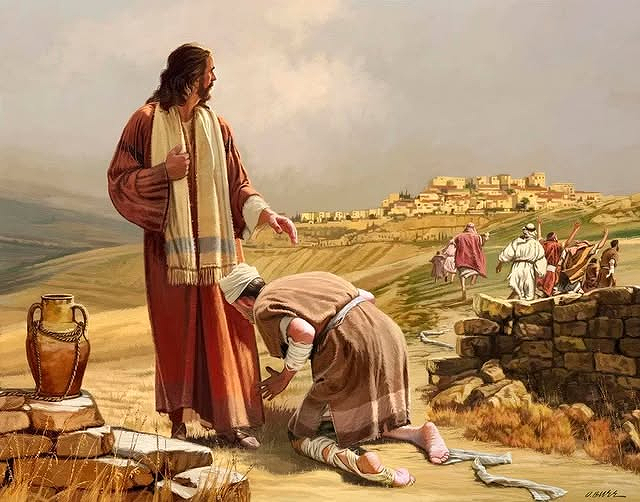
Today’s passage comes from Luke 17:11-19. It is well known and shows the healing of ten lepers by Jesus. As I read this, I sensed there was a little more to this story than I have realized thus far so I took some notes and fleshed it out and what do you know! It’s *rich* with insight and meaning! So, let’s look more closely 
First, the story: On His way to Jerusalem, Jesus was passing through Samaria and Galilee and came to a “certain village” (that presumably could have bordered both areas and had Jew and Samaritan lepers living in the same colony) and from afar a leper in a group of ten raised his voice saying, “Jesus, Master, have mercy on us!” To which Jesus said, “Go, show yourselves to the priests.” Jewish law said that lepers could only rejoin the community after a priest examined them and declared them healed. As they were healed on the way, one of them—a Samaritan—returned and “with a loud voice glorified God and fell down on his face at His feet, giving Him thanks.” Jesus answered him, “Were there not ten cleansed? But where are the nine? Were there not any found who returned to give glory to God except this foreigner?” Then he said, “Arise go your way. Your faith has made you well.”
So now to examine this story more closely. First of all, leprosy was often understood to be one possible consequence of sin in one’s life. Back in the book of Exodus, Moses’ sister Miriam was struck with leprosy for speaking against Moses for his marriage to an Ethiopian wife. She was cast out of the community for a week until Moses’ prayed for her forgiveness and healing. Speaking to Dennis this morning, he explained that the 9 lepers that did not return to thank and praise are representing the 9 lost tribes of Israel—the Jews who were scattered abroad for failing to thank God for His repeated mercy and deliverance. They stubbornly rebelled in idolatry and sin and failed to repent and were taken into captivity by the Assyrians eventually in 722 BC.
Many of the Jewish elite—the ungrateful and unbelieving Pharisees, scribes, and lawyers—and even the general community that for example He claimed followed Him because they had eaten their fill of bread after the feeding of the 5000, were ungrateful and unbelieving. The grateful Samaritan leper is much like the Samaritan woman that ran to tell her town that she had met the Messiah, believing with gratitude in Him and giving Him loud praise as she ran to declare the Messiah to her town. To this woman, He said, “Salvation is of the Jews” and yet many Jews did not believe and some even rejected Him. The Gentile centurion also believed and said He could just speak the word and his servant would be healed. This is another example of faith in God in a foreigner. Of that man, Jesus said in Matthew 8:10, “Truly I tell you, I have not found anyone in Israel with such great faith.”
So what does this faith the lepers had have to do with their healing? In the section preceding this in Luke 17:5-10, Jesus said that if you have faith as a mustard seed, you could tell this mulberry tree to be uprooted and planted into the sea and it will obey. Right after that He said that when a master’s servant has finished his work out in the fields and comes home, he first prepares his master dinner before eating himself, expecting no thanks because he is merely doing his duty. So too are we merely doing our duty to God when we believe and trust in Him with but a mustard seed of faith. This mustard seed first repents of our sin in worship of His sovereign will to forgive us if He chooses, prepared to turn from our sin to a new life of righteousness, just as the lepers were repentant and willing to turn from their sin to go and be reconciled to God through the priests at the Temple.
We do not do this duty expecting thanks from God for doing His will or even expecting reward with any kind of presumption that He owes us anything. Rather we are to do this much like David described in Psalm 40:11-16 saying, “Do not withhold your mercy from me, LORD; may your love and faithfulness always protect me. For troubles without number surround me; my sins have overtaken me, and I cannot see…Be pleased to save me, LORD…may all who seek you rejoice and be glad in you; may those who long for your saving help always say, ‘The LORD is great!’” This grateful Samaritan called out in faith that Jesus’ mere word from a distance could make him whole.
And he returned with praise and thanksgiving saying, “The Lord is great!” just like David’s prayer. He was as a true Jew was called to be and included in Christ’s salvation, just as His blood covers and heals Jew and Gentile alike. Not only did he hope in this salvation with faith, but he even took steps of faith towards the priest in obedience to Jesus’ command even before he was actually healed. We too are called to take steps of faith in obedience trusting we will be healed on the way to the priest—on the way to our complete reconciliation with God, just as we pursue His righteous teaching and follow Him on our way to our final judgment visiting our High Priest (and Judge) Jesus to be fully saved into His heaven. We are shown in this story that God wants us too to take steps of faith even before we are made whole.
Much like a mulberry tree with its deep, extensive root system, a condition like leprosy can be hard to remove and have deep roots in sins that we may struggle with especially. What is one sin that we may have a hard time uprooting and require God’s healing help with overcoming? Forgiveness. And what do we find in the section just before the mulberry tree and the cleansing of the lepers? A passage about forgiveness! In Luke 17:1-4, Jesus says we will all be offended (hurt or harmed), but woe to the one by whom offenses come (in other words, it is God who will deal justice to them). Our duty in faith is to forgive them if they come to us with repentance, even 7 times a day or 77 times (in Matthew 18:21-22). In Matthew 6:14-15, Jesus warns us that God forgives us when we forgive others, but He will not forgive us if we do not also forgive others. Paul also exhorted us to forgive in his letter to the Colossians in chapter 3, verse 13 saying, “Bear with each other and forgive one another if any of you has a grievance against someone. Forgive as the Lord forgave you.”
Sometimes our grievance is with God Himself. When our condition is as challenging and our suffering as bad as one with leprosy, it can be easy to, at the least, complain or to be angry with God. We must uproot that mulberry tree though, repenting and calling out, Lord have mercy, trusting by His word He can forgive and heal us even as we obey taking steps of faith to the Temple in Jerusalem (to the contrition we cultivate in the “Temple of the Jerusalem” in our hearts) to be reconciled to our Priest and be declared “clean!” one day.
Amazingly, we find this exact call in the section right after the lepers in Luke 17:20-21. Here the Pharisees asked Jesus when the kingdom of God will come and He told them, “The kingdom of God does not come with observation; nor will they say, ‘See here!’ or ‘See there!’ For indeed the kingdom of God is within you.” When we find ourselves as lepers too, stuck suffering in our bitterness and wound and anger in the sin of unforgiveness, we must find our healing just like Luke 10:9 describes in the kingdom of God and as we see here, the kingdom of God lies within us, in a contrite heart of repentance and faith in God’s mercy as we take steps of faith towards reconciliation and follow our Savior home.
So let us soften our hearts today and find hope in a God who willed to cleanse 10 lepers (even 9 ungrateful ones!) with but a mere word and command to go and be reconciled to their priest (our priest being Jesus, just like the Samaritan leper as we were once foreigners to the gospel). Let us by a mere mustard seed of faith, uproot our mulberry tree of unforgiveness and sin and plant it in the sea of God’s mercy and redemption where we can find healing for our open sores and wounds. Let us realize we need even more than reconciliation to our Priest Jesus—we were made to praise Him and “with a loud voice glorify God,” bowing at His feet in reverent gratitude for the miracle of His love and mercy and healing. Let us rejoin the community of the faithful in our cleansing and rejoice for this reunion. Thank You Lord for forgiving and healing us by Your blood and sacrifice. Amen.
Artist: Dan Burr